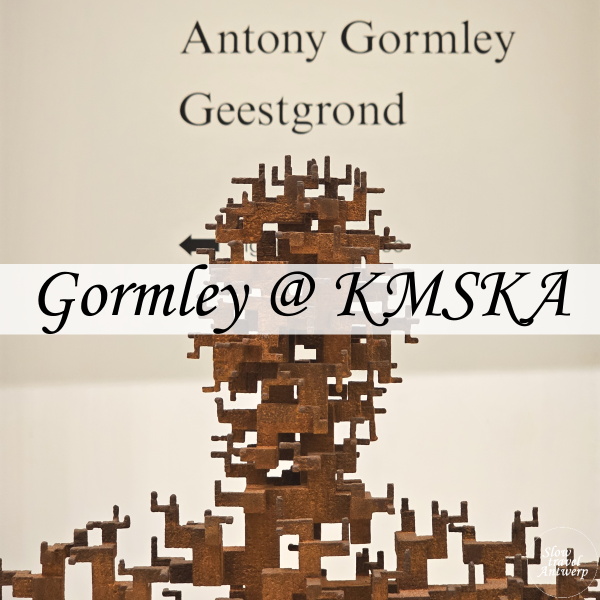
Geestgrond – Antony Gormley
KMSKA
Leopold de Waelplaats 1, Antwerp
22/05/2026 – 20/09/2026

Antony Gormley
Late last year we, as guides, were told that a major exhibition of the British sculptor Antony Gormley was being organized at the KMSKA. I didn’t know his work very well, but I was pleasantly surprised at the preliminary presentation of the exhibition. I even already had a favorite room (which would later end up in second place).
Antony Gormley had already been to the museum and had specifically requested the museum’s white rooms instead of the standard exhibition halls. It was primarily the brightness and the light that appealed to him. When you enter the familiar rooms now, you notice this as well. The lighting was adjusted for this exhibition; it is now much brighter than in the standard layout. Gormley indicated that the building calls for bodies that breathe.
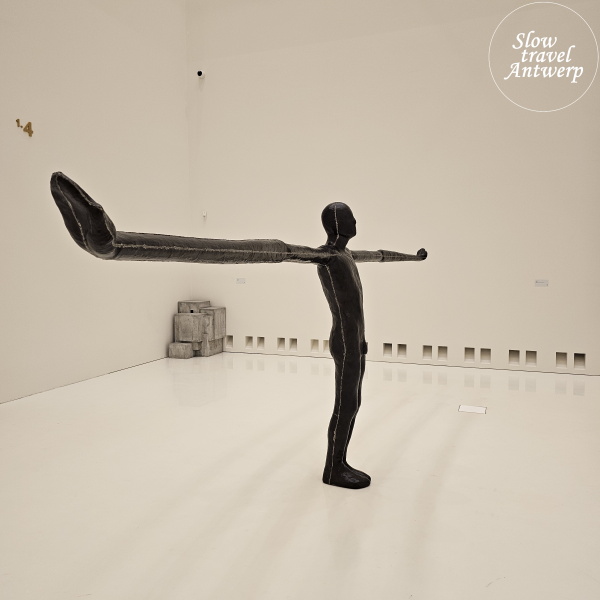
Inside and outsede the museum
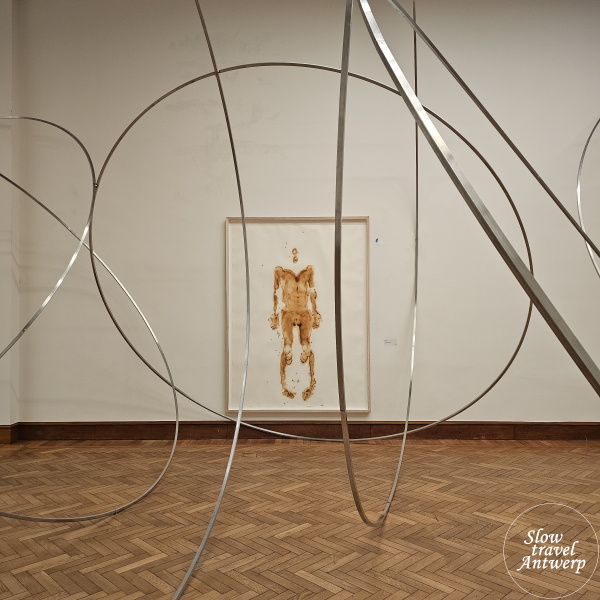
I knew him from his figures. But his work is so much broader than that, and you notice that in the exhibition as well. In the first (real) exhibition hall, you will find a lot of early work by Gormley, such as his lead works and ‘Mother’s Pride’. The “(real)” in the previous sentence is because Gormley also wants to show works outside the exhibition halls. Even outside the building, there are three works from the Domains series (next to the fountain, on the roof to the right, and on the Scheldt quays). Inside, too, there are a few works to be found before you enter the actual exhibition: ‘Brace’ leaning against a wall in the De Keyserzaal, ‘Small Stop Lead VII’ behind the female statues, and of course ‘Orbit Field III’, through which you are allowed to dance.
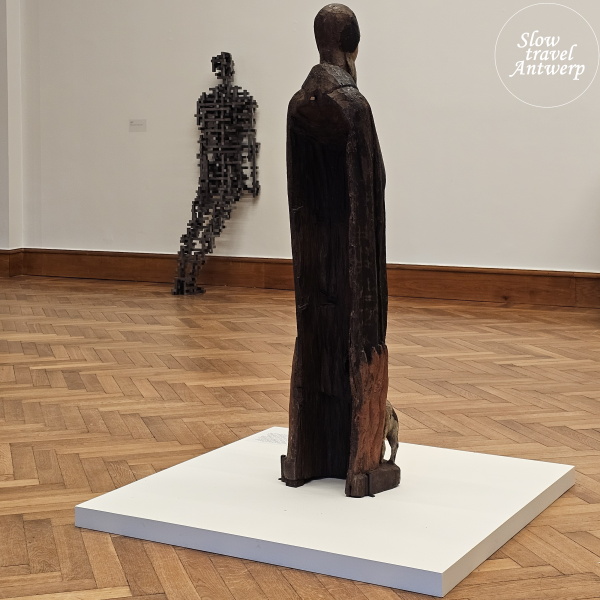
Geestgrond
A great deal of thought went into the title of the exhibition. The director considered ‘Ecce Homo’, but Gormley found that somewhat pretentious. Guest curator Carolyn Christov-Bakargiev and Antony Gormley then heard of ‘Geestgrond’. Geestgrond is actually a type of Dutch agricultural land, but it possesses a great deal of symbolism. It represents the relationship between ‘spirit’ or consciousness and ‘ground’ or earth. The material and the immaterial that are also contained within Gormley’s work. They also simply thought it sounded beautiful with the g’s and the r, which is why the title is not being translated.
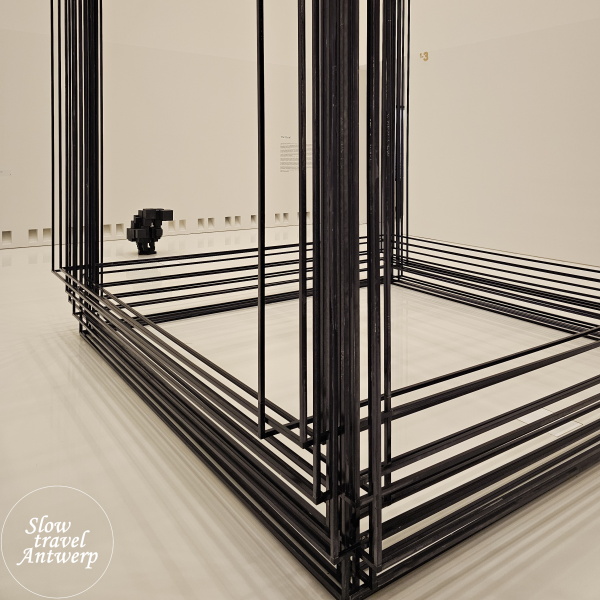
Murmur, the Heart & Cave
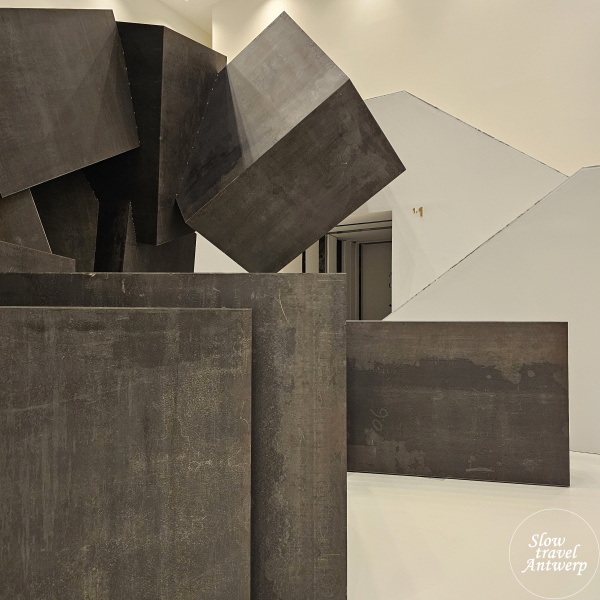
At the first images of the exhibition, I thought ‘Cave’ was going to be my favorite. This artwork is a collection of cube-shaped cavities that form a body. The body as a building that you can enter. Gormley thought it was a bit hysterical to provide helmets, but there are very low spaces and the starting point is not the lowest. He prefers that lights (from mobile phones) are not used to find your way. It provides the best experience by finding your way by touch.
In the former Ensor Room stands a shimmering sort of cube and a kneeling figure. ‘Murmur’ is the expansion of ‘Form IV’. This is difficult to grasp; Gormley admits that he doesn’t always get it either. It seems as if the works were made for this space, which is why they are my favorites. The small rooms between ‘Cave’ and ‘Murmur’ feature ‘The Heart’, and it is as if you are stepping into Gormley’s studio. There are a few books from his personal collection, held together by a giant clamp, but also materials, photographs, drawings, and models. Here you truly feel his art.
Guided tours
You will also see me there as a guide, or to come and take another look at the works. If you would like a guided tour, you can always indicate this when booking or let me know.
I will be guide for the upcoming English-language walk-in tours on the following dates:
- 17/07 – 14u
- 24/07 – 14u
- 31/07 – 14u
- 7/08 – 14u
- 14/08 – 14u
- 28/08 – 14u
Tickets via the KMSKA website: https://kmska.be/en/event/walk-in-tour-antony-gormley
What is there to see in Antwerp


Geestgrond – Antony Gormley